
Balancing customer experience vs business outcomes is the kind of high-stakes juggling act that wears you out. You’re expected to build lovable products and drive hard metrics. And somehow do it all without frustrating customers, losing stakeholder trust, or burning out.
You’re not imagining the pressure. You’re probably being asked to support sales, reduce churn, grow revenue, increase acquisition, and make the user experience smoother—all at the same time. Meanwhile, everyone’s got an opinion about what should go on the roadmap.
Here’s the good news: you don’t have to pick sides. The most effective product leaders don’t treat customer satisfaction and business goals as competing priorities. They build alignment between them.
Let me show you two frameworks that help product leaders do exactly that. They’re practical, easy to implement, and make roadmap decisions far less reactive.
Why This Tension Feels Harder Than Ever
The product role has expanded, but the resources haven’t. You’re juggling inputs from sales, support, engineering, marketing, and execs. Your team gets stuck defending priorities instead of executing them.
And let’s be honest: not every request is strategic. But saying “no” can feel political. And saying “yes” to everything leaves you swamped and misaligned.
When there’s no shared clarity around how customer value connects to business outcomes, everything becomes a negotiation. That’s exhausting.
But when you have the right tools, you can shift the conversation from “Why can’t you just build this?” to “Does this move the metric we all agreed on?”
That’s what the following two frameworks do: they give you the language, structure, and evidence to make better trade-offs and build long-term trust.
Framework 1: Define Your North Star Metric
Your North Star Metric is the clearest signal that your product is working—for both customers and the business. It connects product usage to real value.
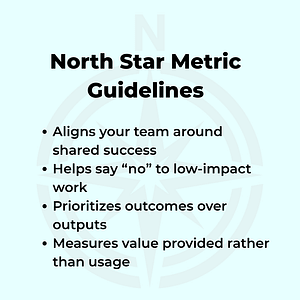
Not vanity value (like logins or pageviews). Actual outcomes that reflect why people use your product—and how that usage drives revenue, retention, or growth.
A good North Star Metric helps your team:
- Make faster, more confident decisions
- Say no to low-impact work
- Focus on outcomes instead of outputs
- Build shared language with stakeholders
Examples of strong North Star Metrics:
- For a SaaS product: Monthly active subscribers completing core workflows
- For a marketplace: Successful transactions per active user
These metrics are actionable, tied to customer value, and predictive of business impact.
A Real Example from the Field
I worked with a team buried in requests—sales wanted lead-gen tools, success needed onboarding improvements, and marketing had a wishlist of analytics.
We stepped back and asked: what really matters?
After some discovery, we aligned on a North Star Metric: weekly active users completing key workflows.
This gave them a filter:
- Onboarding? High-impact. It helped users reach value faster.
- Lead-gen features? Lower priority—didn’t affect the core user journey.
- Analytics? Reframed to support user success in workflows.
Same backlog. Sharper focus. Better decisions.
Framework 2: Use the Impact vs Effort Matrix
Once you have your North Star, you still need to navigate resource constraints. You can’t build everything—even if it’s good. This is where the Impact vs Effort Matrix comes in.
It’s simple but powerful.
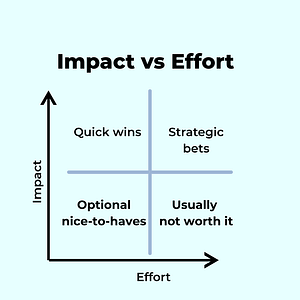
You map each idea, request, or initiative along two dimensions:
- Impact: Will this move the North Star Metric? Will it help customers succeed?
- Effort: How long will this take to build? What’s the true cost?
You’ll end up with four buckets:
- High Impact / Low Effort → Quick wins
- High Impact / High Effort → Strategic bets
- Low Impact / Low Effort → Optional nice-to-haves
- Low Impact / High Effort → Usually not worth it
How This Plays Out
One team I coached had a backlog full of sales customization requests. Each one was high effort and only useful to one client.
By mapping them on the matrix, it became obvious: most were low impact / high effort.
Rather than flat-out rejecting them, the team grouped requests by theme and built shared solutions with broader reach—ones that were more impactful and less resource-intensive.
The result? Sales still got support. But the roadmap didn’t derail.
How These Two Frameworks Work Together
When used in combination, these tools bring structure to your roadmap:
- Your North Star Metric sets the direction
- The Impact vs Effort Matrix helps you decide how to get there
Every request now goes through two filters:
- Will this move the needle on our North Star?
- Is the impact worth the effort?
If yes, it’s a priority. If not, you’ve got a solid reason to say no—or defer.
And most importantly, these aren’t private filters. They’re frameworks you can share openly with stakeholders, so everyone understands how and why decisions are being made.
Build Space for Trade-Off Conversations
These tools only work if you’re using them with your team and stakeholders, not just in your head.
That means setting aside regular time to revisit priorities, evaluate new information, and talk about what’s changing.
One of the most overlooked leadership practices is explicitly naming what you’re not building—and why. Those trade-off conversations build more trust than any deck or roadmap doc ever will.
Try hosting monthly or quarterly roadmap checkpoints. Review your North Star Metric. Walk through your Impact vs Effort Matrix. Ask what’s changed, and adjust together.
I’ve seen product teams go from constantly defending their decisions to proactively shaping conversations. Stakeholders start seeing you as a strategic partner, not a blocker.
Common Mistakes to Avoid
Here are a few pitfalls I see when teams start using these frameworks:
- Choosing a North Star Metric that’s too business-heavy or too user-focused. It needs to represent the intersection.
- Treating the Impact vs Effort Matrix as static. It should evolve as you learn more.
- Using frameworks as shields instead of tools. They’re not meant to shut people down—they’re meant to open up better conversations.
- Excluding stakeholders from the process. If other teams don’t understand your process, they won’t trust your priorities.
This Isn’t Just About Tactics—It’s About Trust
The goal here isn’t to score quick wins or avoid hard conversations. It’s to create long-term alignment between your team and the rest of the org.
When people see how customer experience connects to business outcomes, and how you’re choosing what to build (and what not to), they stop second-guessing. They start collaborating.
I’ve seen it firsthand: teams move from reactive to focused. From constantly defending themselves to getting proactive support.
That’s what happens when product decisions feel transparent and strategic—not random or political.
Want Help Making This Real?
If you’re trying to balance product-led vision with commercial pressure, these frameworks will help—but implementation is where the real work begins.
That’s what I coach product leaders through every day.
We’ll tailor your North Star Metric, set up practical ways to use the Impact vs Effort Matrix, and align your stakeholders around shared context. No theory, no fluff—just tools that actually shift how your team works and how you’re seen across the business.
Let’s stop choosing between customer outcomes and business outcomes. Let’s build alignment that serves both. Book a call with me to learn more.
