

Few things are more frustrating than silence—especially when it comes to getting customer feedback in product management. You send the messages, post the prompts, maybe even offer a “quick 15-minute chat”… and nothing. Just radio silence.
One of my coaching clients—an experienced product leader at a SaaS startup—found themselves smack in the middle of this. Solid product. Happy users. But when it came to actually talking to those users? Nothing. No interviews. No follow-ups. Just a stream of polite non-responses.
Even the most satisfied customers? Quiet. Sure, they left five-star ratings and some public praise. But real, actionable feedback? Nowhere to be found.
Why Quiet Users Are a Real Problem
This team had done a great job: smooth UX, minimal friction, helpful onboarding. The kind of product users breeze through.
But that ease came with a hidden cost—no obvious “pause points” where people reflect or share thoughts. And when things went wrong? Oh, the feedback flooded in (sometimes with extra spice). But when things went right? Customers just… moved on.
So the team was stuck. How do you learn what’s working when no one’s talking?
How We Got Customers Talking Again
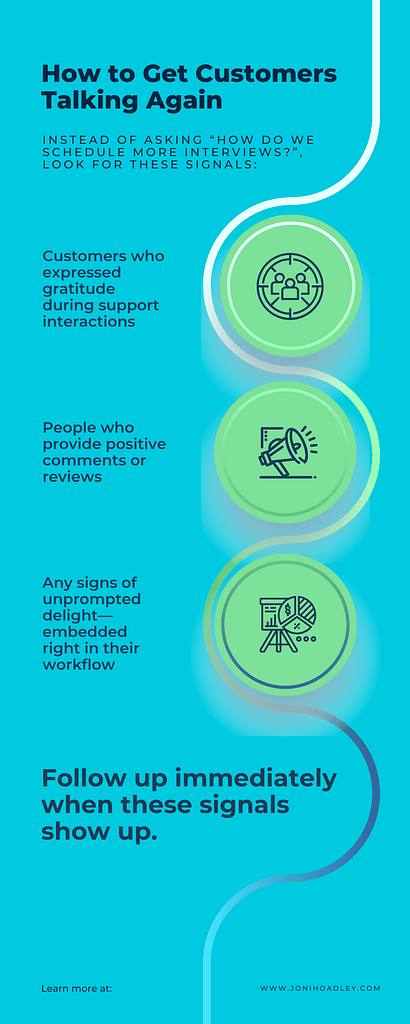
Instead of asking “How do we schedule more interviews?”, we zoomed out.
The better question:
When are users most likely to talk to you?Joni hoadley
Here’s what we looked for:
- Customers who expressed gratitude during support interactions
- People who left thoughtful, positive comments in the product or in follow-up messages
- Any signs of unprompted delight—embedded right in their workflow
We set up a simple rule: follow up immediately when those signals showed up.
That one change? It unlocked higher response rates, richer conversations, and a sharper understanding of what was actually driving success.
What Product Managers Can Learn From This
If your users are quiet, it doesn’t mean they don’t care. It might mean you’re:
- Asking at the wrong time
- Asking in a way that feels like a sales pitch
- Missing subtle signals of enthusiasm
1. Start Where Feedback Already Exists
Before chasing interviews, review what people are saying:
- Support tickets
- Feature requests
- Replies to your product updates
- Comments in user forums
There’s gold in the unprompted stuff.
2. Set Up Real-Time Alerts for Positive Moments
If someone says something kind—on a call, in an email, in-app—capture it. Tools like Intercom, Slack integrations, or even shared inbox tags can help flag these moments so you can follow up fast.
3. Be Explicit: “This Isn’t a Sales Call”
Users will ghost you the second it feels like a funnel. Be honest:
“We’re just looking to learn. No pitch. No pressure.”
It lowers defenses and builds trust.
4. Offer a Small Thank You (Not a Bribe)
You don’t need to throw gift cards at people. But a kind gesture—early access, a sneak peek, a shout-out—goes a long way.
Don’t Just Chase Traffic. Learn From It.
This product leader’s team didn’t stop at getting more feedback. They also:
- Reviewed where people dropped off in the user journey
- Clarified confusing parts of the product and purchase experience
- Used support data to rewrite onboarding copy
- Ran small experiments to tweak the conversion flow—one variable at a time
Even while under pressure to hit targets, they carved out time for learning loops. The payoff? A more confident team and a stronger product strategy.
Look for the “Quiet Signals”
If your inbox feels empty, it doesn’t mean your product’s a flop—or flawless. It means it’s time to look at feedback differently.
And if you’re stepping into a new PM role and want to build stronger systems for customer learning from day one?
👉 Let’s talk about how I can help you build a better approach—before the silence sets in.